


In This Article
BiggerPockets members have spoken. Their verdict: cautious optimism.
Within the model new BiggerPockets Pulse survey, BP members have been requested to fill out their expectations for 2026. Regardless of a yr of sluggish frustration in many markets, these surveyed really feel usually good about doing offers in 2026, with hopes for decrease rates of interest and affordability in stabilizing markets, signaling a delicate altering of the winds in favor of traders trying to construct their portfolios.
The Solely Means Is Up
Make no mistake, this isn’t the frenzied euphoria of 2020-2022, however extra of a “the one approach is up” sentiment following current charge drops and information of elevated stock within the gentle of the affordability disaster.
BiggerPockets members’ sentiments align with nationwide forecasts of an general steadier market. Realtor.com expects rates of interest to common round 6.3% in 2026, down barely from 2025, whereas house worth progress is predicted to be modest. Virtually talking, that might lead to elevated shopping for alternatives for even handed patrons, however not a dramatic correction.
BiggerPockets members have learn the market accurately, which is why most plan to construct their portfolios moderately than sit on the sidelines.
The Residence Worth Development Map: What’s Up With Atlanta and Indianapolis?
The BiggerPockets house worth progress map for 2026 exhibits a noticeable divergence between markets anticipated to develop and people the place momentum has stalled or reversed. Georgia and Indianapolis, actual property stars in previous years, have fallen into the latter class, dropping over 5%. It has had a marked impact on how each residents and patrons really feel about their native markets.
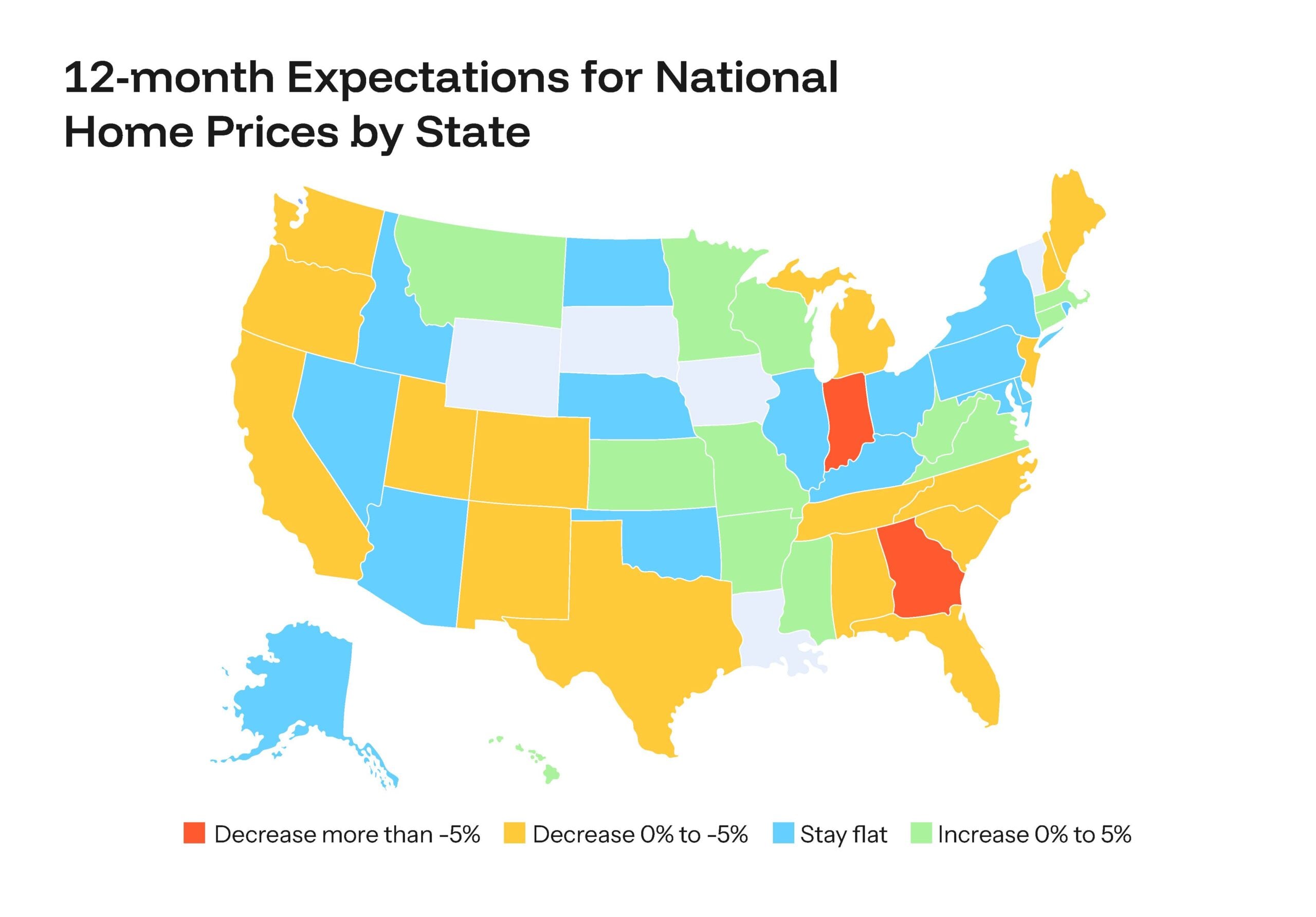
“Hotlanta” is now not scorching
Atlanta was as soon as an funding rock star with an exuberant post-pandemic market. The forecast drop in gross sales is because of softening rents, increased insurance coverage and property tax prices, and a smaller pool of patrons capable of afford peak-era costs. Buyers within the Atlanta space might do nicely to attend for the market to backside out earlier than making a transfer, and money stream at present costs might be laborious to come back by.
Indianapolis: A confounding image
BiggerPockets knowledge estimates over a 5% drop in home costs in Indiana. Nevertheless, sure markets will expertise better declines than others. HousingWire reported on the finish of 2025 that Indianapolis noticed sellers minimize costs on 56% of properties amid rising stock and low absorption charges.
Regardless of the seemingly alarming numbers for each Atlanta and Indianapolis, the metros are a good distance from crash territory. As an alternative, they’re transitioning away from the frenzied worth will increase of 2020 to 2022 towards a extra mundane market with slower appreciation.
In each instances, ready for the market cycle to run its course earlier than leaping in appears prudent for traders.
Development Markets: Gradual, Regular, and Nonetheless Inexpensive
In case you’re making an attempt to formulate an funding technique, the Northeast, Midwest, and pockets of the inside South might show a contented searching floor, in keeping with the BiggerPockets house worth?progress map. States anticipated to understand by greater than 5% are:
Arkansas
Connecticut
Kansas
Massachusetts
Minnesota
Mississippi
Missouri
Montana
Virginia
West Virginia
Wisconsin
Chilly Northeast Markets Current Lengthy-Time period Alternatives
Realtor.com shares an analogous opinion with New York markets corresponding to Rochester and Syracuse, that are near Rhode Island and Connecticut, the place Hartford, Connecticut, one other fast-appreciating metro, is situated, the place appreciation is predicted to be within the double digits. These markets are highlighted by their comparatively low housing costs, inhabitants progress, and restricted housing provide.
Many of those cities are benefiting from massive investments from the tech sector. For cautious patrons, these markets can provide the holy trinity of affordability, regular progress, and money stream—as long as you purchase proper.
You may additionally like
Definitely, in comparison with many metros, these cities provide a safer possibility. Nevertheless, many sections of those cities haven’t but “turned the nook,” with excessive crime nonetheless a problem, corresponding to in Syracuse, which implies patrons should be cautious of stepping right into a tenant landmine.
Why Possession Charges Have an effect on Rental Stock
Nationwide knowledge exhibits that as of Q2 2025, 65% of U.S. householders personal their properties, whereas 35% lease, with variations by state. States within the Midwest and South typically have increased homeownership charges, and thus tighter gross sales inventories—elements that assist worth stability and reasonable appreciation.
Decrease costs right here equate to better affordability for each householders and renters. This contrasts with some of the South and West markets, the place speedy building and worth escalation have resulted in flat or declining rents, stagnant or damaging worth progress, and affordability points for a lot of would-be patrons.
In brief, it’s laborious to put money into many Sunbelt markets in comparison with extra steady markets elsewhere, the place the numbers nonetheless work, demand is diversified, and forecasts point out slower, sturdy appreciation.
Renters, House owners, and the Prices
Deciding the place to speculate must be balanced with stats regarding rental demand. Simply because a metropolis is inexpensive and appreciating doesn’t imply there can be a excessive demand for rental housing.
Whereas the typical homeownership numbers across the nation is 65%, in states corresponding to West Virginia, Maine, and Minnesota, possession spikes to over 70%, in keeping with DoorLoop, whereas dear states corresponding to California, New York, and Nevada see actual percentages approaching 40%, far above the nationwide common of 35%. Within the dearer states, it’s a lot more durable to make money stream numbers make sense.
Steady Single-Household Rental Markets
Excessive possession, lower-cost states and metros corresponding to West Virginia, Delaware, Michigan, Maine, and Vermont are likely to assist steady single-family leases as a result of residents prize homeownership, in keeping with visualcapitalist.com, however not everybody should purchase initially.
These renters have a better probability of finally turning into patrons, however begin out by renting a single-family house—the subsequent neatest thing. As costs rise in single-family markets, the probability of renting for longer will increase, however the dangers of investing additionally rise because of better leverage.
Remaining Ideas
Inserting BiggerPockets Pulse responses alongside nationwide forecasts, a coherent funding technique emerges for 2026. Within the face of a spectacularly unspectacular housing market, BiggerPockets members are specializing in long-term leases and portfolio constructing, moderately than speculative appreciation or short-term leases.
For depreciating markets corresponding to Atlanta and Indianapolis, regulate underwriting accordingly and purchase proper, beneath current comps, anticipating the markets to backside out or watch for them to take action. In falling house worth markets, sellers are determined, creating alternatives for savvy patrons.
In home-price progress markets, traders can not afford to let the identical disciplined protocols slip. Figuring out stable, progressively rising—mid?single digits—moderately than exuberantly rising markets is the important thing to long-term progress. Coupled with that is the necessity for wholesome gross sales exercise, affordability, and revenue and employment ratios beneath 30% for each renters and householders.
Layering savvy funding methods, corresponding to forcing fairness by way of rehab and holding lengthy sufficient to learn from gradual appreciation, on prime of different metrics, will make sure the one factor BiggerPockets traders covet most: a reliable, long-term cash-flowing rental.




